


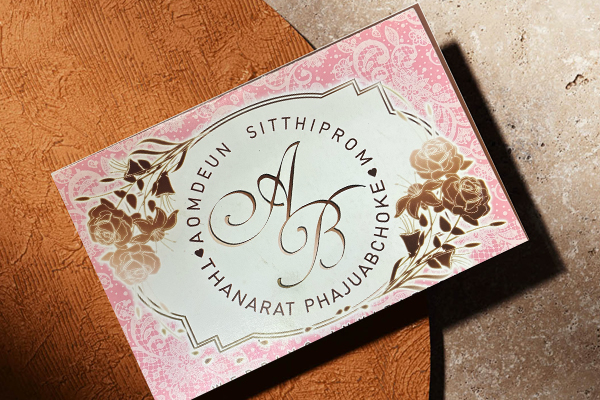
Wedding Invitations: Essential Media for Informing Guests and Setting the Tone
A wedding invitation is a card used to inform guests about the event details and set the tone of the wedding. You should confirm the date, time, venue, and theme before designing to minimize revisions and errors before printing.
Information to Include in a Wedding Invitation
The invitation should contain all core information on a single page so guests can read and decide immediately.
- Names of the bride and groom, and parents' names if necessary.
- Date, month, year, and ceremony start time.
- Venue name, brief address, and a navigation link or QR code.
- Schedule, such as registration time, ceremony, and reception.
- Color theme or dress code for guests who wish to dress accordingly.
- RSVP channels, such as LINE, phone number, or a form.
Wedding Invitation Design
Choose a style that matches the event first—such as formal, minimal, traditional, modern, or botanical—then adjust the text, fonts, colors, and graphics accordingly.
- Make the bride and groom's names the most prominent element.
- Date, time, and venue must be easy to read and not blend into the background.
- Use highly legible fonts, especially for the names, date, and venue.
- Test the QR code using multiple phones before printing.
- Leave a safe margin of at least 5–7 mm around the card to prevent text from getting cut off.
Paper Size and Envelope Selection
The most recommended size for a wedding invitation is a 5 x 7-inch card inside an A7 envelope (5.25 x 7.25 inches). It offers perfect space for information, is easy to read, and envelopes or printing services are easily found. We recommend a paper thickness of around 270–350 gsm for the card, and 100–120 gsm for the envelope.
Which Size Should You Choose?
- Choose 5 x 7 inches if you want a complete-looking card with perfect space for text, photos, and a QR code without needing to fold.
- Choose 4 x 6 inches if you need to control the budget, print in large volumes, or use it merely as a save-the-date or introductory card.
- Choose 4 x 9 inches if you want a beautiful and modern vertical design, but be prepared for potentially higher envelope and postage costs.
- Choose square if you want a premium feel and mailing is not your primary distribution method.
Paper Thickness
How to Choose an Envelope
Choose an envelope about 0.25 inches larger than the card on all sides so it's easy to insert and remove without being too tight. For example, a 5 x 7-inch card should use an A7 envelope (5.25 x 7.25 inches).
Steps to Prepare and Produce Wedding Invitations
- Confirm the date, time, venue, and ceremony sequence.
- Choose a template or hire a designer based on your theme.
- Insert text, photos, maps, and QR codes.
- Thoroughly check spelling, dates, names, and links, especially for bilingual cards.
- Request a proof from the print shop before actual production.
- Select paper, envelopes, embellishments, and the required quantity.
- Test fitting the card into the actual envelope to ensure a perfect fit before ordering.
Pre-Printing Checklist
“Why Choose Rewat Printing?”
Principles for Choosing and Using Wedding Invitations
- • Choose themes and fonts that align with the event's atmosphere, such as formal, minimal, traditional, or modern.
- • Always verify the date, time, names, venue, links, and QR codes before sending to print.
- • Test inserting the card and extra elements into the actual envelope before production to prevent sizing issues.
Summary
A wedding invitation is more than just a request to attend; it clearly communicates the event's details, theme, and image. Choosing the right size, paper, and envelope, along with careful proofing before printing, ensures your cards are beautiful, functional, and delivered to your guests with confidence.
