


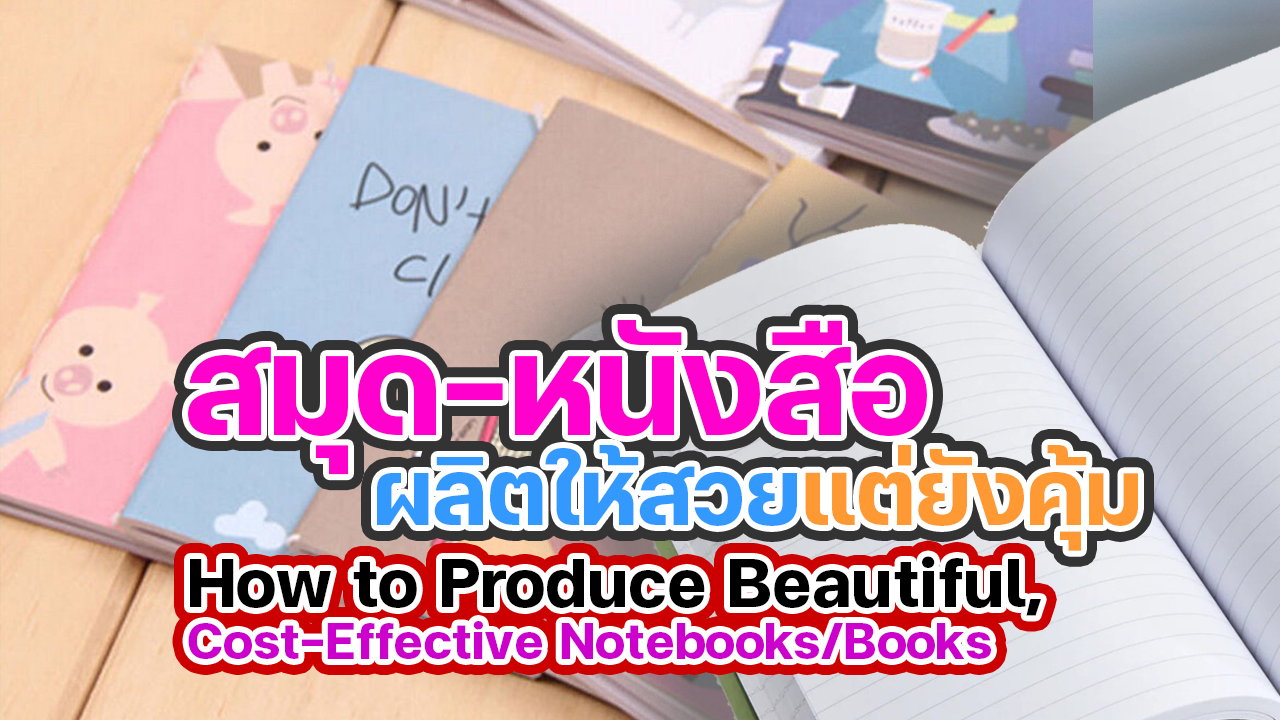
How to Produce Beautiful, Cost-Effective Notebooks and Books
If you want to produce notebooks or books through a printing house in Buriram that are “affordable yet beautiful”, the key is to choose the right size, paper, binding method, and print quantity for Rewat Printing that suit your budget. You should not add every possible decorative feature.
Cost-Saving Principles
- Choose standard sizes such as A4, A5, or 14.8 × 21 cm, because they allow more efficient paper cutting and printing-plate layout than custom sizes.
- Print general content in black and white, and use color only for the cover or key pages to reduce ink and printing costs.
- Order a larger quantity if you are certain, you can sell or distribute the books, because the cost per copy will decrease. However, if you are still testing the market, ask Rewat Printing to produce a small digital-print run first.
- Reduce the number of pages and use appropriate margins, focusing on an easy-to-read layout rather than adding more pages.
Making It Look Premium Without High Costs
|
Decorative feature |
Cost-effective option |
When to use it |
| Cover |
Matte or gloss-coated art card |
Suitable for general notebooks and books |
|
Logo/title |
Embossing or small Spot UV areas |
When you want a premium look while controlling costs |
|
Special color |
Gold or silver foil stamping on the logo only |
Corporate gifts or higher-end products |
|
Binding |
Perfect binding for paperback books; saddle stitching for thin booklets |
Choose based on thickness and intended use |
| Hardcover |
Use only for gift notebooks or premium products |
Adds durability and a premium image |
Rewat Printing’s Recommended Formulas
PUR binding offers stronger adhesion, greater flexibility, and better long-term durability than conventional hot-melt glue, making it suitable for higher-quality books.
◉ Books or manuals: Matte-coated softcover, black-and-white interior, perfect binding. If you need greater durability and a book that opens flatter, consider PUR perfect binding or thread sewing.
Color-to-Black-and-White Page Ratio for Cost-Controlled Book Production
For books where cost control is important, a commonly cost-effective ratio is approximately 20–30% color pages, with the remaining pages in black and white. Arrange the color pages in consecutive groups of four pages to reduce plate-making and press-change costs.
|
Book type |
Color pages |
Black-and-white pages |
Suitable for |
|
Maximum savings |
0–10% | 90–100% |
Manuals, text-based books |
|
Balanced cost and image |
20–30% | 70–80% |
Textbooks, reports, reference books |
|
Image-focused but budget-conscious |
30–40% | 60–70% |
Children’s books, product manuals |
|
Fully image-focused |
100% | 0% |
Photo books, premium catalogs |
Cost-Saving Page-Layout Rules
- Arrange color pages in consecutive groups of four, such as pages 1–4, 13–16, and 33–36. Do not scatter single color pages throughout the book, because even a few color pages may require an additional four-color printing plate, making the job more expensive than printing several additional color pages.
- This four-page formula works well for perfect-bound books in A4, A5, A6, B4, B5, and B6 sizes.
- For saddle-stitched books, print either the entire book in color or the entire book in black and white, because mixing color and black-and-white pages is more complex and costly.
- If you already have color pages, add more images or important pages to the existing color groups rather than creating additional color-plate groups.
