


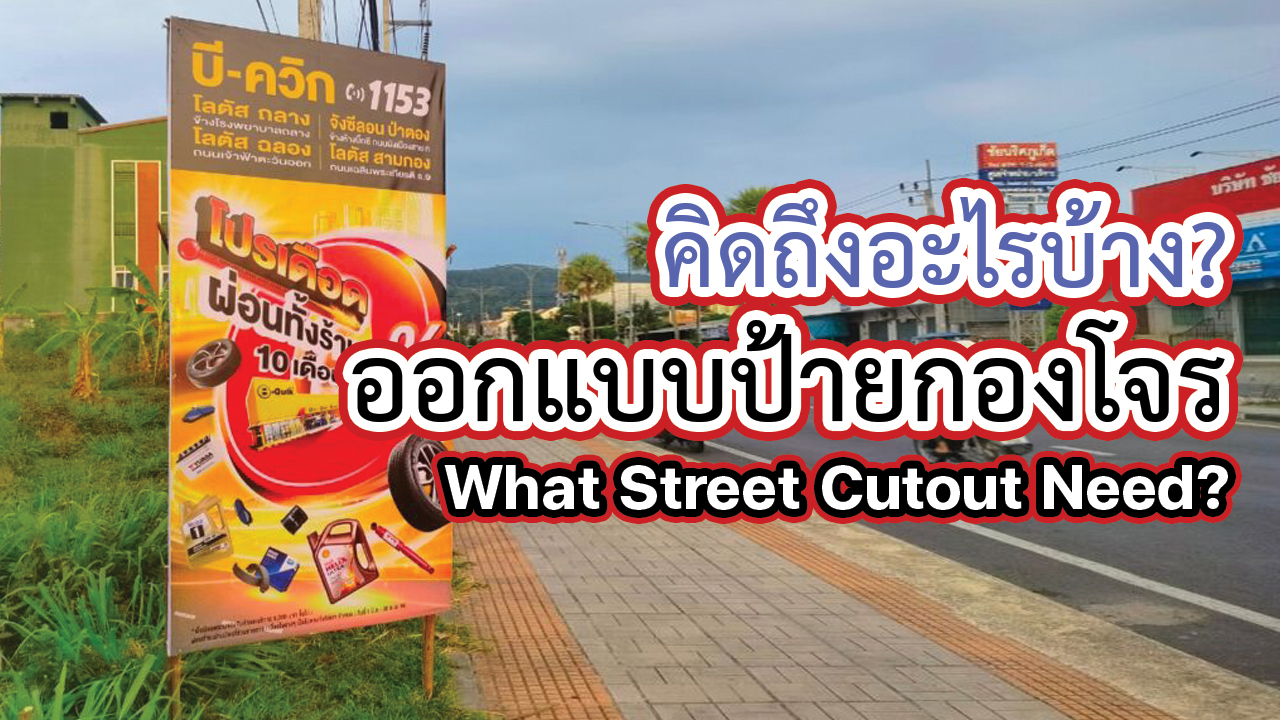
When designing a street cutout, what should you consider?
The core principle of street cutout design is to make passersby understand the message within 3 seconds. It should communicate only the single most important message and clearly tell viewers what to do next.
The 3C Design Principles
Easy-to-Read Sign Structure
| Section | Design Guidline |
|---|---|
| Logo | Place it top left or top center; it should not overpower the headline. |
| Headline | Use bold, short, impactful wording that immediately communicates the main benefit. |
| Offer | State the discount, price, distance, or key differentiator as briefly as possible. |
| CTA | Place it in a contrasting color block or framed area, such as “Call 0X-XXX-XXXX.” |
Design and Printing Guidelines
- Use bold sans-serif fonts, such as DB Heavent, Anuphan, or Helvetica Thai. Avoid italics and thin strokes because they are difficult to read from afar or while driving past.
- Follow a clear typographic hierarchy: the headline should be the largest, followed by the offer, then a CTA that is prominent enough to be remembered.
- If using a QR code, make it large enough to scan from the distance where a person is standing or has stopped their vehicle. Include a short explanation of what they will receive after scanning.
- Test the design in real lighting conditions and at the actual viewing distance before mass production to confirm that it can be read in time.
Placing Signs Effectively
Choose locations where your target audience actually passes by. People generally begin noticing and looking at a sign from around 500–600 meters away.
If the signs tell a story step by step, space them approximately 400–600 meters apart—for example, the first sign creates interest, the next presents the offer, and the final sign encourages the CTA. Angle the sign toward oncoming traffic by about 10–20 degrees, with its center approximately 1.0–1.4 meters above the ground for good visibility without obstructing sightlines.
Important Precautions
In many cases, street cutouts are installed in public areas without permission. Therefore, check local regulations and obtain approval before installation to reduce the risk of removal or legal action. Avoid locations that obstruct traffic, block traffic signs, or negatively affect the community’s image. Street Cutout marketing often relies on unconventional public-space tactics, so permission and responsible placement are essential to avoid complications.
Effective guerrilla signage must communicate quickly, be clearly legible from a distance, feature a compelling offer, and include a clear call to action (CTA)—all while being placed in an appropriate and legal location.
